

No products in the cart.



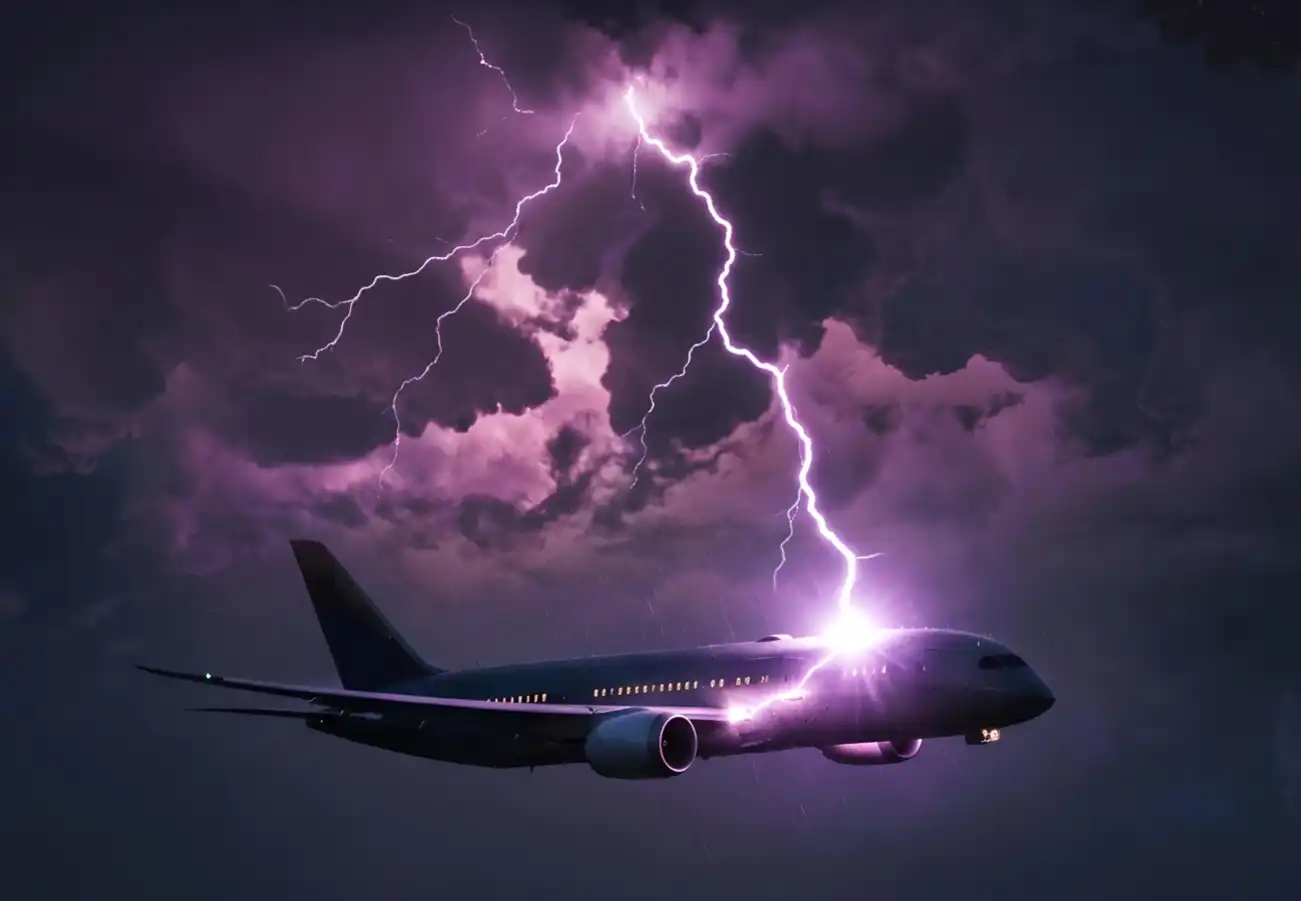
What Really Happens When Lightning Strikes an Airplane Amazing Facts That Will Change How You View Flying
What Really Happens When Lightning Strikes an Airplane? Amazing Facts That Will Change How You View Flying!
Fear of the Unknown Above the Clouds!
Imagine you’re seated in your window seat, watching the clouds build up, when—suddenly—the quiet of the flight is torn apart by a flash of lightning that hits the wing. For many passengers, this moment becomes the peak of fear. The questions that immediately come to mind are: Are we in danger? And can this aircraft withstand such a massive electrical charge?
The truth—one that may surprise you—is that lightning strikes on commercial airliners are considered everyday occurrences around the world. Yet flights continue to operate with complete safety, thanks to engineering genius that turns this threat into a passing event.
Lightning Strikes Aircraft Every Day—So Why Don’t They Go Down?
Although the frequency of lightning strikes may seem frightening, experts in the aviation industry emphasize that modern aircraft are designed to become part of the lightning’s electrical circuit—not its victim. The key lies in proactive design that accounts for the harsh working conditions above the clouds.
“Commercial aircraft are designed to absorb lightning strikes.”
— Professor John Hanzman, professor of aeronautics and astronautics, and director of the International Center for Air Transportation at the Massachusetts Institute of Technology (MIT).
Under strict safety protocols, any aircraft struck by lightning must undergo a detailed inspection after landing. In most cases, engineers find that the aircraft’s structure is either completely sound or has only very minor damage that does not affect structural integrity or its ability to fly.
A Lesson from the Past: How a 1967 Incident Changed Aviation History
The safety we enjoy today is not the result of luck—it is the outcome of hard lessons learned from aviation’s past. According to Scientific American magazine, the most recent commercial airline crash in the United States directly caused by lightning occurred in 1967, when a lightning strike led to an explosion of the aircraft’s fuel tank.
That incident became a major turning point. It pushed engineers to develop advanced technologies to protect sensitive systems. Today, electrical wiring is isolated and components such as avionics equipment and fuel tanks are carefully installed to prevent the formation of electric arcs. This precise design ensures that no spark forms that could ignite fuel vapors—making lightning only a visual phenomenon rather than an explosion hazard.
The “Faraday Cage” Secret: How the Aircraft Protects Its Passengers
When lightning strikes an aircraft, it follows a physical concept known as the “Faraday Cage.” The aircraft’s structure (the fuselage) acts as a protective container that prevents electromagnetic fields from entering the interior. Professor Hanzman explains that lightning typically “seeks” sharp edges, such as the nose of the aircraft or the tip of a wing.
Instead of penetrating the cabin, the electrical energy flows along the exterior surfaces of the aircraft’s body, then exits safely through the tail. This external path protects passengers and electronic systems from electrical stress, keeping everyone inside safe within this protective metallic shield.
The New Challenge: Carbon Fiber and Modern Aircraft
As the industry shifts toward efficiency, airlines have begun using composite materials such as carbon fiber in aircraft like the Boeing 787 and the Airbus A350 to reduce weight. However, these materials pose a physical challenge because they conduct electricity less than traditional aluminum.
To meet this challenge, manufacturers developed a smart engineering solution: integrating additional metal wires within the composite material structure. This metal network ensures a continuous, highly conductive path along the exterior surface. As a result, lightning can pass through the modern aircraft’s body with the same smoothness and safety as it does through older metal aircraft.
Why Do You See Planes Chart Curved Paths to Avoid Thunderstorms?
If lightning is not a serious threat to flight safety, then why do pilots work hard to fly around storms?
The truth is that avoiding storms is not primarily about fear of lightning itself. It relates to other factors that are more physically dangerous.
Hanzman explains that the main reason is severe atmospheric turbulence that comes with storms, or the risk of hail, which can cause damage to physical surfaces—such as the aircraft’s exterior—or to engines. As for lightning, Hanzman clearly states:
“It is not a serious safety issue.”
Conclusion: A Safe Flight Despite Storms
Thanks to precise engineering and our deep understanding of physics, lightning has changed from a terrifying threat into a technical display that is handled with remarkable flexibility.
Today’s aircraft are designed to be airborne fortresses that protect you from nature’s most powerful phenomena—so you can enjoy your flight without worry.
The next time you see a lightning flash illuminate the horizon from the plane window, will you feel fear—or will you be amazed by this engineering ingenuity that carries you safely through the heart of the storm?